QUESTION 25 (5 marks)
Molecular sequence data from two proteins was used to determine the relatedness of giant pandas, red pandas, polar bears and ferrets. The graph shows the mutation rate of the two proteins used in the investigation.
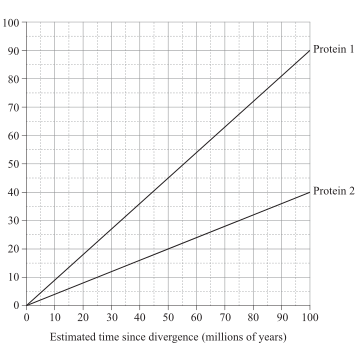
Number of amino acid differences (per 100 residues)
The table shows the average number of amino acid differences observed (per 100 residues) in protein 1.
Giant panda | Red panda | Polar bear | Ferret | |
Giant panda | 44 | 18 | 43 | |
Red panda | 45 | 36 | ||
Polar bear | 44 | |||
Ferret |
a) Infer which species is most closely related to the ferret.
[1 mark]
b) Predict the number of amino acid differences (per 100 residues) between polar bears and red pandas for protein 2. Justify your response.
[2 marks]
c) Use your knowledge of convergent and divergent evolution to explain why molecular sequence data is often more accurate than anatomical data for determining the relatedness of different species.
[2 marks]
QCAA guide · typeset solution
QCAA sample response and mark allocation
25a) | The red panda | • infers red panda [1 mark] |
25b) | According to the table, polar bears and red pandas had 45 amino acid differences in protein 1. This suggests they diverged approximately 50 million years ago. The protein 2 line on the graph indicates that species that diverged 50 million years ago will have ~20 amino acid differences per 100 residues. | • predicts 20 amino acid differences [1 mark] • provides appropriate justification [1 mark] |
25c) | Both types of evolution may result in organisms with similar structures, but in divergent evolution, structural similarity is due to the short period of time since divergence (i.e. organisms are closely related), whereas in convergent evolution, similarity is due to similar environments. This means that some organisms have similar features without being closely related, so physical features aren’t always a reliable indicator. | • distinguishes between divergent and convergent evolution [1 mark] • explains the difference in accuracy [1 mark] |
QCAA sample response and marking criteria reproduced from the official guide.
Compare your working with the guide above.