QCEVault

Continuity of life on Earth — Question 20

QCAA 2024, Paper 1 · 1 mark

Q20 · 2024 · Paper 1Unclassified1 mark

QUESTION 20

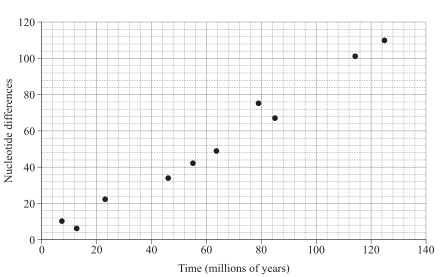
The graph shows the number of nucleotide differences observed in the cytochrome c gene of 10 species and their time since divergence.
Biology question figure

Cytochrome c genes from two new species were compared and found to have 60 nucleotide differences. Based on this information, the two species diverged approximately

(A) 48 million years ago.

(B) 60 million years ago.

(C) 72 million years ago.

(D) 120 million years ago.

Related questions

  1. Q6 · 2025 QCAA · Paper 1 · 1 mark
    QUESTION 6 A student investigating the impact of a selection pressure on a population collected the data shown. Genotype BB Bb bb Number of individuals 128 220 85 Calculate the frequency of the recessive allele in the population. (A) 10% (B) 20% (C) 32% (D) 45%
    Continuity of life on Earth
  2. Q8 · 2025 QCAA · Paper 1 · 1 mark
    QUESTION 8 Speciation is more likely to occur between two populations when (A) gene flow is low and selection pressures are similar. (B) gene flow is high and selection pressures are similar. (C) gene flow is low and selection pressures are different. (D) gene flow is high and selection pressures are different.
    Continuity of life on Earth
  3. Q13 · 2025 QCAA · Paper 1 · 1 mark
    QUESTION 13 The cladogram shows relationships for species P, Q, R, S and T. P Q R S T hair amniotic egg four limbs backbone What inference can be drawn? (A) Species Q, R and S form a clade. (B) Species P and R are more closely related than species P and T. (C) The most recent common ancestor of species R and T had four limbs. (D) Species Q and R have a m…
    Continuity of life on Earth
  4. Q17 · 2025 QCAA · Paper 1 · 1 mark
    QUESTION 17 Which mode of evolution involves the development of complementary characteristics in two species experiencing a close and long-term interaction? (A) coevolution (B) parallel evolution (C) divergent evolution (D) convergent evolution
    Continuity of life on Earth