QUESTION 11 (6 marks)
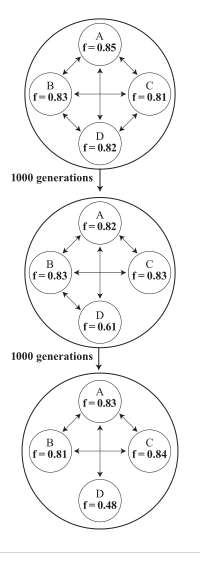
The image shows changes in the frequency of a particular gene in a single species of bird, leading to a speciation event. These changes have occurred over a period of successive time points (i.e. I, II and III) each separated by approximately 1000 generations.
• The letters A, B, C and D represent separate niches inhabited by the birds.
• The arrows depict gene flow between the niches.
• The allelic frequency for the gene is shown as f in each niche.
I
II
III
Draw a conclusion about the type of speciation that has occurred in this population. Explain your reasoning by referring to the information provided in each of the time points.
QCAA guide · typeset solution
QCAA sample response and mark allocation
11 | At time point I, there is equal gene flow and equal allelic frequency in all niches, indicating a high degree of interbreeding between all niches. Trends show that the niche labelled as D has a progressive decrease in allelic frequency of the gene from time point I to time point III. This is supported by gene flow halting between C and D at time point II and then further from B to D at time point III. Gene flow between niches A, B and C remains constant throughout all time points, as shown by the arrows and also by the constant allelic frequency. This evidence supports a potential speciation event at niche D. Niche D however is not totally isolated as there remains some gene flow to the other populations (through niche A). This excludes allopatric speciation as the mode of proposed speciation. There is however an element of population isolation through niches, which supports parapatric speciation over sympatric speciation. | • identifies 3 pieces of evidence of speciation • infers that speciation is not allopatric because D is not isolated, e.g. at III, there is still gene flow with niche A • concludes that parapatric speciation occurred at D | 6 marks | Evidence of speciation includes: at time point I, there is equal interbreeding between all niches over time, the frequency of the gene decreases at niche D by time point III, gene flow ceases between C–D and B–D or other suitable response consistent with a reasonable understanding. |
• identifies 3 pieces of evidence of speciation • concludes that parapatric speciation occurred at D | 5 marks | |||
• identifies 2 pieces of evidence of speciation • concludes that parapatric speciation occurred | 4 marks | |||
• identifies 2 pieces of evidence of speciation • concludes that speciation occurred at D OR • identifies 3 pieces of evidence of speciation | 3 marks | |||
• identifies 2 pieces of evidence of speciation | 2 marks | |||
• concludes that parapatric speciation has occurred OR • concludes that speciation occurred at D | 1 mark |
• does not satisfy any of the descriptors above. | 0 |
QCAA sample response and marking criteria reproduced from the official guide.
Compare your working with the guide above.