QUESTION 22 (4 marks)
The following cladogram proposes the evolutionary history of several fish phyla (A–H).
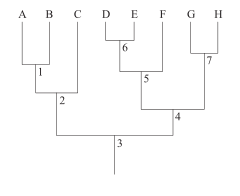
a) Define the term clade. Circle an example of a clade on the cladogram.
[2 marks]
Note: If you make a mistake on the cladogram, cancel it by ruling a single diagonal line through your work and use the additional cladogram on page 13 of this question and response book.
b) Which node (1–7) represents the most recent common ancestor for species E and G?
[1 mark]
c) Which two species shared the most recent common ancestor?
[1 mark]
QCAA guide · typeset solution
QCAA sample response and mark allocation
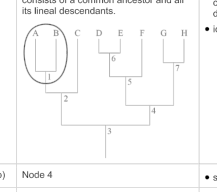
22 | a) | A clade is a group of organisms that consists of a common ancestor and all its lineal descendants. | • states that a clade is a group of organisms that consists of a common ancestor and all its lineal descendants [1 mark] • identifies a clade [1 mark] | A clade must include all lineal descendants from a common ancestor. Note: Circle must include the node (common ancestor). |
22 | b) | Node 4 | • states node 4 [1 mark] | |
22 | c) | D and E | • states D and E [1 mark] |
QCAA sample response and marking criteria reproduced from the official guide.
Compare your working with the guide above.